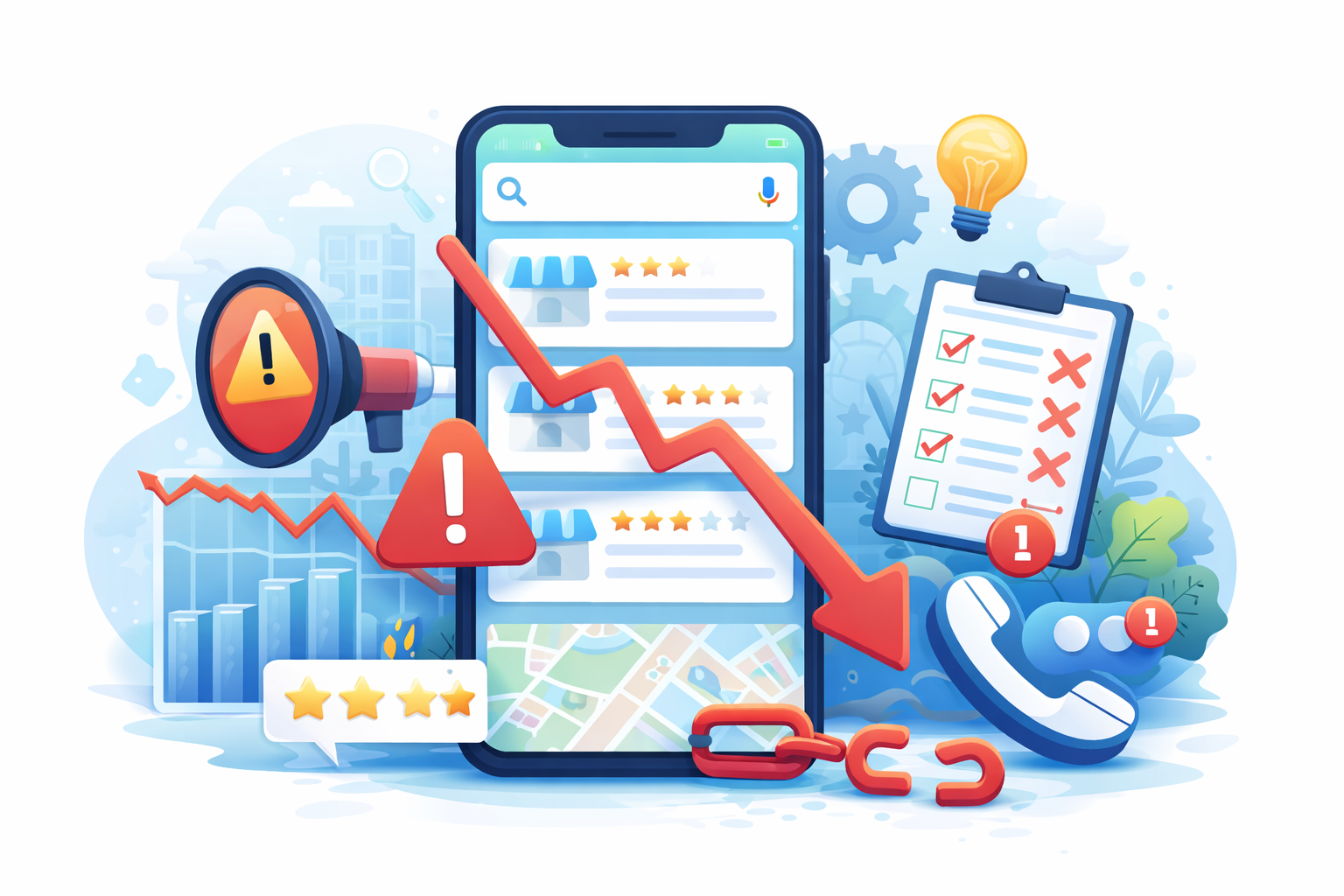
A sudden Google Business Profile ranking drop is one of the most alarming things a local business owner or agency can experience. One week you’re in the top 3. The next week you’re on page 2. The phone stops ringing. Before you panic — most ranking drops are diagnosable and fixable. Here are the seven most common causes and what to do about each.
Article Image — inserted by writer
Caption: Screenshot of the Google Business Profile dashboard showing ranking signals.
1. Your Google Business Profile Went Inactive
Google rewards activity. Profiles that post consistently, respond to reviews, and update their information signal to Google that the business is engaged and trustworthy. When activity stops — no posts, no review replies, no photo uploads — Google interprets this as a signal that the business may no longer be operating.
The fix is straightforward: resume consistent activity immediately. Post at least 3-4 times per week, respond to every review within 24 hours, and upload fresh photos regularly. If you’re managing this manually it’s easy to let slip — which is exactly why automation exists.
LeadSnap publishes posts, replies to reviews, and schedules photos automatically — so your profile stays active whether you log in or not.
Watch: How to diagnose a GBP ranking drop in 10 minutes10:24
Video: Patric walks through how to identify and fix the most common GBP ranking drop causes.
2. An Unauthorized Profile Edit Was Made
Google allows anyone to suggest edits to a business listing. In most cases Google accepts these suggestions automatically without notifying the business owner. A competitor, a customer, or simply an algorithm update can change your business name, address, category, or hours — and you’d never know unless you were watching.
Log into your Google Business Profile dashboard immediately and audit every field. Check your business name, primary category, service area, phone number, website URL, and hours. Even a small discrepancy — a suite number missing from your address — can hurt your NAP consistency and tank rankings.
3. Your Citation Data Is Inconsistent
Citations are mentions of your business name, address, and phone number (NAP) across the web — directories like Yelp, Apple Maps, Bing Places, and hundreds of others. Google cross-references these citations to verify your business information is accurate. When your NAP data is inconsistent across directories — different phone numbers, old addresses, misspelled names — it erodes Google’s confidence in your listing.
Run a citation audit to find and fix inconsistencies. If you’ve moved locations, changed phone numbers, or rebranded in the last few years, outdated citations are almost certainly contributing to your ranking drop.
4. A Competitor Increased Their Activity
Sometimes your rankings drop not because you did anything wrong — but because a competitor got more aggressive. A local competitor who starts posting daily, accumulating reviews, and building citations can push you down the map pack without you changing a thing.
Use a ranking heatmap to identify which competitors are outranking you and in which areas of your service territory. This tells you exactly who you’re competing with and where, so you can focus your efforts strategically rather than guessing.
“
A competitor getting more aggressive can drop your rankings without you changing a single thing.
5. You Lost Reviews or Your Rating Dropped
Google has been removing reviews more aggressively in recent years — legitimate reviews sometimes get caught in spam filters. If your review count drops or your average rating falls, it can directly impact your map pack position.
Monitor your review count and rating weekly. If you’ve lost reviews, you can flag them for reinstatement through Google’s support process — though success rates vary. More importantly, accelerate your review acquisition to rebuild your count.
6. Your Primary Category Changed
Your GBP primary category is one of the most important ranking signals Google uses. If your category was changed — either by you, by a suggested edit, or by a Google algorithm update — it can dramatically shift which searches your profile appears for.
Audit your primary and secondary categories. Make sure your primary category reflects your core service as specifically as possible. ‘Plumber’ ranks for different searches than ‘Emergency Plumber’ or ‘Drain Cleaning Service.’
7. Google Updated Its Local Algorithm
Google updates its local search algorithm regularly. Some updates cause widespread ranking volatility that affects thousands of businesses simultaneously. If your ranking dropped suddenly with no obvious internal cause, check local SEO forums and communities to see if others are experiencing the same thing.
If it’s an algorithm update, the best response is patience and continued activity. Profiles with consistent signals — regular posts, active review management, clean citation data — tend to recover faster and more fully than inactive profiles.
The fastest way to rule out causes 1, 2, and 3 is to run LeadSnap’s automated diagnostics. Connect your GBP and LeadSnap will flag inactive signals, detect unauthorized edits, and surface citation inconsistencies automatically.
Ranking drops feel urgent because they directly affect your phone calls and revenue. But most causes are fixable within 30–60 days with the right activity. Start by auditing your profile for unauthorized changes, check your citation consistency, and resume consistent posting and review activity immediately.
